
In 1898 the chocolate manufacturer Antoni Amatller, who was also a philanthropist, amateur photographer and glasswork collector, commissioned the Catalan architect and politician Josep Puig i Cadafalch (1867-1956) to refurbish the building. The current building dates from his "rose” or modernista period, which includes buildings such as the Casa Macaya and the Casa de les Punxes, the House of Spikes. The architect decided to give Casa Amalter the appearance of an urban Gothic mansion, with a flat façade and a central court with a staircase leading to the piano nobile.
Puig i Cadafalch made a highly personal reading of the Neo-Gothic style in the Casa Amatller. The first outstanding feature in the building is its stepped Nordic façade, coated by a sgraffito membrane of ochre and white stucco and crowned by an extravagant Flemish-style gable adorned with red and gold vitrified Valencian tiles.
.jpg/450px-Casa_Batll%C3%B3(1).jpg) The façade, considered by some specialists
to be “the apotheosis of the decorative arts”
and in which some have seen influences of the town houses
of Copenhagen, Brussels and Amsterdam, has a bay window of
Wagnerian inspiration that recalls the façade of the
Sant Jordi Chapel in the Palau de la Generalitat (Plaça
de Sant Jaume). Puig i Cadafalch sprinkled the house with
his typical mediaeval details. The entrance, for example,
is decorated with sculptures, capitals and stucco work such
as the stone figure of Saint George killing the dragon by
Eusebi Arnau. The figures on the windows of the main floor
recall the fantastic and grotesque creatures that decorate
Gothic mansions and churches. Also on the ground floor there
is a jeweller’s shop that has respected the small original
windows with floral ornamentation that are inspired by Catalan
Gothic mansions.
The façade, considered by some specialists
to be “the apotheosis of the decorative arts”
and in which some have seen influences of the town houses
of Copenhagen, Brussels and Amsterdam, has a bay window of
Wagnerian inspiration that recalls the façade of the
Sant Jordi Chapel in the Palau de la Generalitat (Plaça
de Sant Jaume). Puig i Cadafalch sprinkled the house with
his typical mediaeval details. The entrance, for example,
is decorated with sculptures, capitals and stucco work such
as the stone figure of Saint George killing the dragon by
Eusebi Arnau. The figures on the windows of the main floor
recall the fantastic and grotesque creatures that decorate
Gothic mansions and churches. Also on the ground floor there
is a jeweller’s shop that has respected the small original
windows with floral ornamentation that are inspired by Catalan
Gothic mansions. 
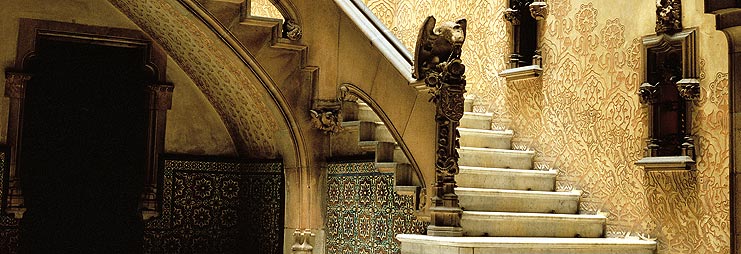
The foyer is decorated with three bronze
lamps and has an elegant staircase leading to the piano nobile,
which houses the Amatller Institute of Hispanic Art, founded
by the Amatller family, an academic institution dedicated
to the study of Spanish art that currently owns the building.

The main floor is one of the few interiors of Barcelona that
still conserve not only much of the original wealth of ornamentation,
but also the opulent gilded atmosphere enjoyed by the bourgeoisie
of the Modernista Eixample, thanks to the sculptures that
adapt to the spaces, the floors of Roman-style mosaic and
white marble, and the ceilings that offer a rich combination
of polychrome beams and sgraffito work. The fireplace is one
of the most outstanding features, though many consider that
the masterpiece of this floor is the pink marble column located
right in the middle of the bay window, which can be seen from
the street -it plays no structural role, but is merely a hedonistic
feature, only intended to offer the pure pleasure of contemplation.
Unfortunately, this house is not open to visitors, but you
can see several pieces of the original furniture at the. You can only visit the caretaker’s office, which has survived intact and
contains one of the finest stained-glass windows of the modernista era.
On the ground floor there is a gallery staging temporary exhibitions.
Admission is free.
Back : Quadrat d'OrTour

No comments:
Post a Comment